Most baby clothing is safe, but some design features can pose hazards to babies and young children. This guide covers the main ones and points to the official sources for current rules and recalls.
Drawstrings and cords
Drawstrings at the neck or hood can catch on cribs, playground equipment and car doors, creating a strangulation risk. In the United States, drawstrings in the hood and neck area of children’s upper outerwear in sizes 2T to 12 are treated as a substantial product hazard by the U.S. Consumer Product Safety Commission (CPSC). Waist drawstrings also have length limits. For babies, avoid cords and ties at the neck entirely.
Buttons, snaps and decorations
- Buttons, beads, rhinestones, bows and pom-poms can detach and become choking hazards.
- Give decorations a firm tug to check that they’re secure, and recheck after washing.
- Snaps should close fully and not have sharp edges.
- Remove any item with a loose small part from use until it is repaired.
Loose threads and hair tourniquets
Long loose threads inside mittens, socks and footed sleepers can wrap around fingers or toes. Turn items inside out occasionally to check, and trim loose threads. A single strand of hair can do the same thing, so if a finger or toe looks swollen or discoloured, seek medical help promptly.
Sleepwear
US federal rules require children’s sleepwear (sizes 9 months to 14) to be flame-resistant or snug-fitting. Hoods, strings and loose accessories don’t belong on sleepwear. For sleep in general, see NIH Safe to Sleep.
Accessories
Headbands, hair clips, necklaces, teething necklaces and pacifier clips with long cords carry choking or strangulation risks, especially during sleep or when unsupervised. The U.S. Food and Drug Administration has warned against teething jewelry.
Checking recalls
Search the CPSC recall list by product and brand. Reports of problems can be submitted to SaferProducts.gov. Outside the US, check your national authority, such as the EU Safety Gate or Product Safety Australia.
Hoods and neck openings
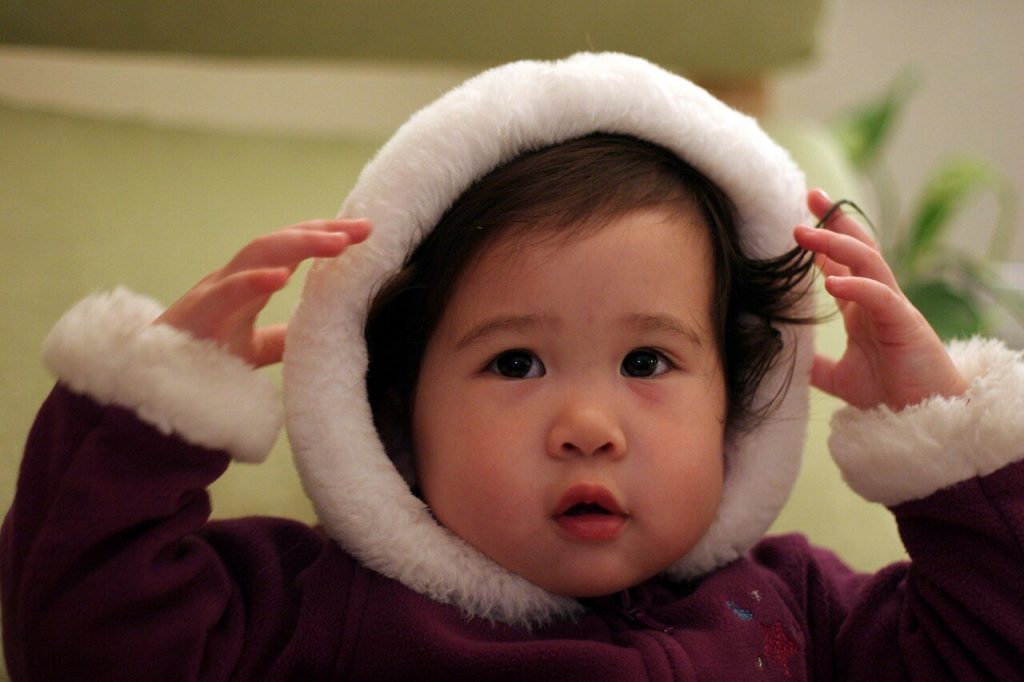
Hoods on outerwear can catch on equipment, and loose hoods can slip over the face of a young baby. Many safety organisations suggest choosing hoods that are detachable or close-fitting, and removing hoods or hooded garments for sleep. Neck openings should be large enough to go over the head easily, without being so loose that the garment slips down over the face.

Elastic, cuffs and tight garments
Elastic that is too tight at the wrists, ankles or waist can leave deep marks. Check fit regularly and size up when elastic digs in. Tights and socks can also be too tight, especially when layered. Our article on when to size up covers the signs.
Sleep-specific safety
- No hoods, strings, ribbons, loose decorations or bibs during sleep.
- Remove hats indoors before sleep, and remove headbands, clips and jewellery.
- Use a well-fitting sleep sack rather than loose blankets.
- Avoid weighted sleep products; the AAP doesn’t recommend them.
- Follow NIH Safe to Sleep and the American Academy of Pediatrics safe sleep guidance.
Costumes and dress-up clothing
Costumes for babies and toddlers can include masks, capes, ties, wigs and small decorations. Masks can block breathing or vision, capes and ties can be strangulation hazards, and decorations can come loose. For babies, simple costume-style sleepers or rompers without extra parts are a safer option. Remove costumes before naps, and check that any costume worn near open flames, such as candles, is flame-resistant.
Car seats and clothing
Clothing affects car-seat safety. Bulky coats and snowsuits can leave harness straps too loose in a crash, and thick aftermarket inserts may not be tested with your seat. Dress the baby in thin layers, tighten the harness snugly, and put a blanket or coat over the harness if needed. See NHTSA car seat guidance for current guidance.
Labels, tags and materials
In the United States, children’s products, including many clothes for children 12 and under, must meet federal limits on lead and certain phthalates, and must carry tracking information on the product or packaging. In the EU, CE marking applies to some children’s products, and the REACH regulation restricts many chemicals in textiles. These are legal requirements rather than voluntary certifications. Our article on textile labels explains the voluntary schemes.
Counterfeit and unbranded products
Counterfeit and some unbranded products sold online may not meet safety rules. Small parts may be poorly attached, and sleepwear may not meet flammability standards. Buying from sellers who give clear manufacturer information, and checking reviews and recall databases, reduces the risk. Report unsafe products to SaferProducts.gov in the US or your national authority.
A quick safety checklist
- No drawstrings or cords at the neck or hood
- Decorations and buttons secure
- No long loose threads inside
- Elastic not too tight
- Sleepwear well-fitting, with no hood or loose parts
- Accessories removed before sleep and when unsupervised
- Product not on a recall list
Babies who are starting to move
As babies start to roll, crawl and pull up, new hazards appear. Long trousers can catch under the feet; non-slip socks or bare feet help on hard floors. Loose items such as bibs and scarves can catch on furniture. Necklaces and pacifier cords become riskier as babies explore. Reviewing clothing and accessories at each new stage keeps them suited to what the baby can do.
This article is general information about clothing, not medical advice. For questions about your baby’s health, skin or sleep, talk to your pediatrician or health visitor.
Discover more from Baby Fashion
Subscribe to get the latest posts sent to your email.