Baby clothing labels look simple: newborn, 0–3 months, 3–6 months and so on. In practice, two items with the same label can fit very differently. This guide explains what the common size labels mean, why they vary, and how to pick sizes with fewer surprises.
Age labels are an estimate, not a rule
An age range on a label is the manufacturer’s guess at which babies will fit the garment. Babies grow at different rates, so a label of 3–6 months is best read as “a baby of roughly this weight and length”. Many brands print a weight and height range next to the age, and those figures are more useful than the age itself.
Common size labels
- Preemie (P): for babies born early or small, usually up to around 2.3 kg (5 lb).
- Newborn (NB): usually up to around 3.6 kg (8 lb). Many babies outgrow this in a few weeks, and some never fit it at all.
- 0–3 months: often around 3.6–5.4 kg (8–12 lb).
- 3–6 months: often around 5.4–7.3 kg (12–16 lb).
- 6–9 and 6–12 months: ranges overlap between brands, so check the weight figures.
- 12, 18 and 24 months: sometimes labelled 12M, 18M, 24M, or 1–2 years in European sizing.
- 2T and up: toddler sizes, cut with more room for walking and nappies or diapers.
European and UK sizing
Much of Europe sizes baby clothing by body length in centimetres: 50, 56, 62, 68, 74, 80, 86 and 92. A size 62 garment is meant for a baby about 62 cm long. This system is more precise than age labels, and it is a helpful cross-check when you buy from brands in different countries.
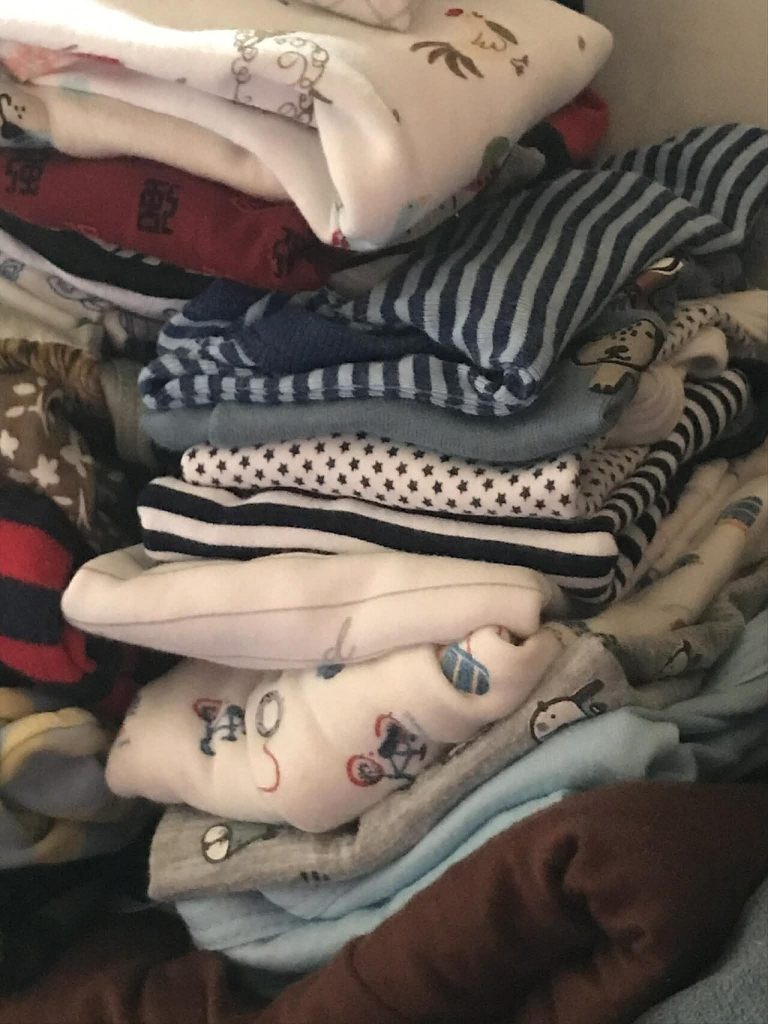

Why the same size fits differently
- Cut: some brands cut slim, others leave room for cloth nappies.
- Fabric: 100% cotton can shrink in the first hot wash; blends with elastane stretch more.
- Garment type: footed sleepers are limited by leg length, while bodysuits are limited by torso length.
Practical tips
- Use your baby’s current weight and length, not their age, when choosing a size.
- When in doubt, size up. Most babies grow into clothes quickly.
- Buy only a few newborn-size items before the birth, because birth weight is hard to predict.
- Wash new cotton items before judging the fit.
Fit also matters for safety. Clothing that is very loose, especially sleepwear, can ride up around the face. For sleep, follow the NIH Safe to Sleep recommendations and choose well-fitting sleepwear.
Weight and length: how to measure
Weight is easy to track at check-ups or with a home scale, but length is often more useful for clothing. One-piece garments such as sleepers and bodysuits are limited by torso and leg length, not weight. To measure at home, lay the baby on a flat surface and measure from the top of the head to the heel with the leg gently straightened. Exact precision isn’t needed; you just want to know which size band the baby falls in.
Your health visitor or pediatrician records weight, length and head circumference on growth charts. These are medical records rather than clothing guides, but the same numbers help you read a size label. If you have questions about your baby’s growth itself, ask your health professional rather than relying on clothing fit.
Toddler sizes and the 18–24 month overlap
Around the end of the first year, sizing becomes less consistent. Some brands label clothes 18–24 months while others jump to 2T, and the two are not always the same. Toddler sizes (2T, 3T) are usually cut longer and narrower, because walking children lose the rounder baby proportions, and they often have less room for a nappy. Size 24 months typically has a little more room in the seat than 2T. If your child is still in nappies, the 24-month version may be more comfortable.
Sizing differences by garment type
- Bodysuits: torso length is the limiting factor. If the snaps strain, size up even if the width still fits.
- Footed sleepers: leg length matters most. Toes should not press against the end.
- Trousers and leggings: more forgiving, because cuffs can be rolled up and waistbands are usually elastic.
- Outerwear: often sized with extra room for layers underneath. Check the label to see whether it’s meant to be worn over other clothes.
- Hats, socks and shoes: sized by head circumference or foot length rather than age on many products.
International size conversions
When you buy from different countries, a rough conversion helps. European length sizes correspond approximately to US and UK age labels as follows. Treat these as guides, because individual brands vary.
- Size 50–56: newborn
- Size 62: 0–3 months
- Size 68: 3–6 months
- Size 74: 6–9 months
- Size 80: 9–12 months
- Size 86: 12–18 months
- Size 92: 18–24 months
Shrinkage and stretch
Natural fibres, especially 100% cotton jersey, can shrink by a few per cent in the first warm wash and tumble dry. Brands that sell pre-shrunk cotton usually say so on the label. Fabrics with elastane recover their shape better and allow a little more growth room. If a garment is borderline, washing it once at the recommended temperature before deciding shows the true size.
Building a wardrobe across sizes
Because babies move through sizes quickly, many families keep only a small number of items in each size and rely on frequent washing. Gifts often arrive in newborn and 0–3 month sizes, so it can help to ask friends and family for larger sizes, or to keep tags on gifts so they can be exchanged. Our newborn wardrobe checklist suggests realistic quantities, and our secondhand checklist covers passing clothes on once they are outgrown.
This article is general information about clothing, not medical advice. For questions about your baby’s health, skin or sleep, talk to your pediatrician or health visitor.
Discover more from Baby Fashion
Subscribe to get the latest posts sent to your email.